
The budget I’m not spending
Last month I was offered something every team lead dreams about: budget to hire. Not a blank check: I’d still have to justify every seat, show where each person would go and why we truly need them. But the door is open. And I’m struggling to say yes.
Not because we don’t need help. We are drowning in work. I’m struggling because, since we started paying for Claude Code, I no longer feel the need for another junior.
That is an ugly sentence to write. It is also the most honest one I have, and it is the reason this post exists.
Three times the projects, same headcount
I lead a small team, 10 to 15 people, inside a much larger company. Until recently we ran two or three serious projects at a time. Today we run five, six, sometimes seven. Each one is big enough that, on its own, it could be the flagship product of a standalone company.
We tripled the number of projects. We did not triple the number of people. The difference is AI agents.
The company noticed the productivity jump and did the reasonable thing: it gave us budget to grow. We hired two juniors. Now they’re asking whether we want more. Right now, I’m leaning toward no.
The ugly math
Here is the calculation running in my head, and I’m sorry for how cold it sounds.
With a junior, I explain the job. What I expect, how to approach it, why it matters. Then I check in. Then I correct. Then I explain again. It takes days, sometimes weeks, of back-and-forth before the work lands where I need it.
With an LLM, I spend 20 minutes describing the problem. I look at what comes back. Often it’s at the level of a junior. Sometimes it’s better, with solutions I hadn’t considered.
And I can run five of those at once. I can’t run five juniors at once without becoming a full-time teacher. So when someone hands me budget, the selfish, efficient part of my brain says: parallelize on agents, not on people. It’s faster.
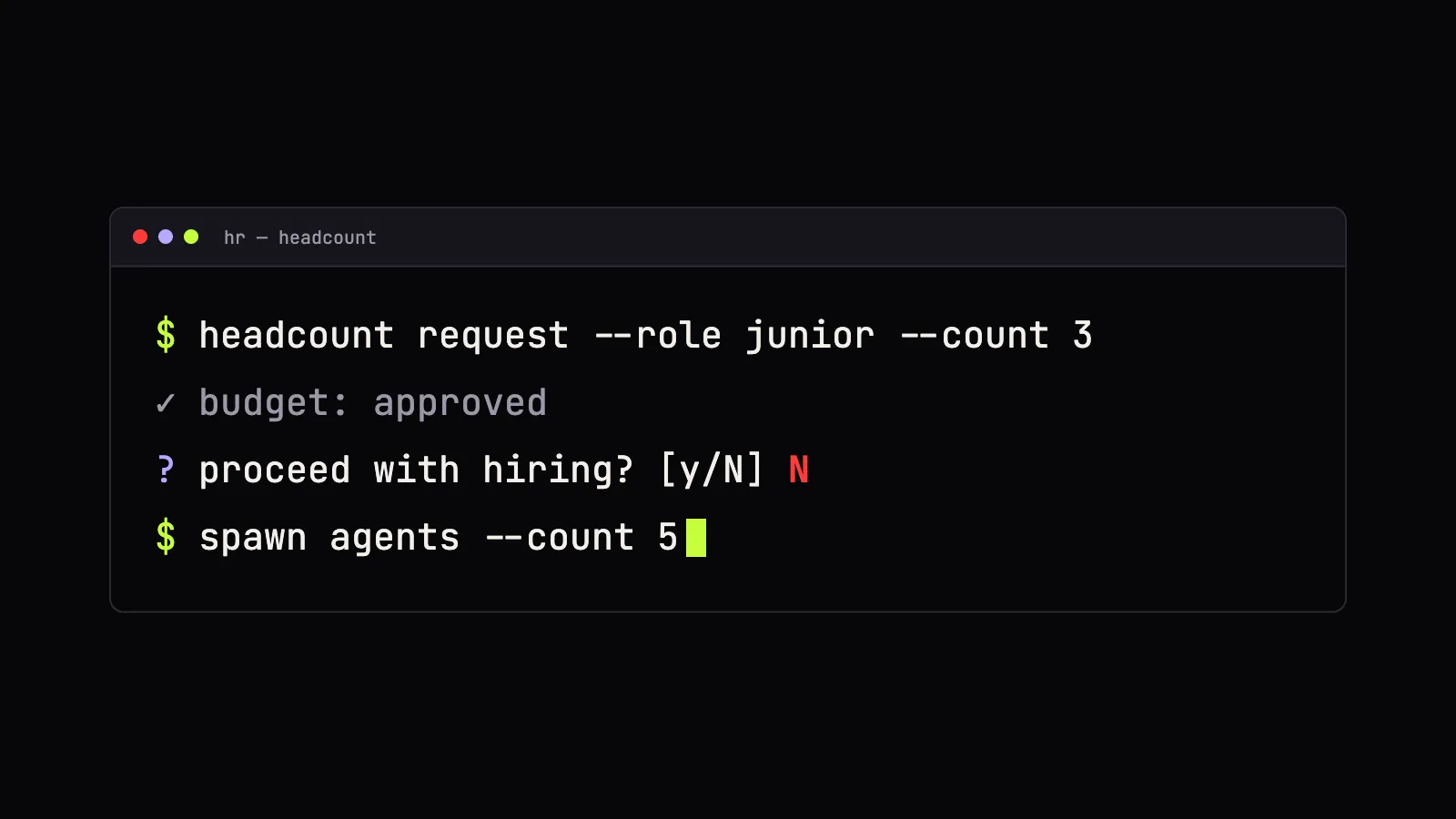
And it’s not just me. Everyone on the team has Claude Code. The seniors use it extremely well, and they’re more productive than they’ve ever been. The two juniors use it too, and on the surface they look faster. But the output isn’t precise, and it takes a few rounds of back-and-forth before it lands. A junior with an agent doesn’t save me the explaining. It just moves it somewhere else.
That part of my brain is right about speed. I’m not sure it’s right about anything else.
What I do anyway
Despite all of this, I keep betting on our two juniors. I still hand them real problems. I still take the time to explain, even when typing the same prompt into an agent would be quicker. I do it on purpose, because nobody becomes a senior without someone spending that time on them. Someone spent it on me.
And honestly, I think the ugly math is wrong. Or at least incomplete.
My 20 minutes with an agent only work because I’m a senior. That prompt is years of experience compressed into a few paragraphs. Without people who build those years, in ten years there will be nothing left to compress.
The agent also doesn’t grow. It gets better when the vendor ships a new model, not because I invested in it. A junior’s cost drops over time: the tenth explanation is shorter than the first, and one day they’re the one explaining things to the next person. A junior is an investment. An agent is an expense. The problem is that a quarterly budget is very good at measuring expenses and very bad at measuring investments.
But I’m aware that, quarter by quarter, this is a choice I’m making against my own incentives. And a system that relies on every team lead choosing against their incentives is not a system. It’s a hope.
If I’m thinking it, everyone is
I’m not special. If this reasoning crossed my mind, it is crossing the mind of thousands of managers with the same tools and the same deadlines. Nobody fires anyone. Nobody makes headlines. The open positions just quietly don’t get filled.
The big forecasts don’t capture this. Goldman Sachs Research puts AI-driven displacement at 6–7% of the US workforce as a baseline, with a range of 3% to 14%, and expects the effect to be temporary. That number measures people who lose a job. It doesn’t measure the jobs that never open.
The early data on that second effect already exists. A Stanford study based on ADP payroll data found a 13% relative decline in employment for 22-to-25-year-olds in the most AI-exposed occupations; for young software developers, employment was down nearly 20% from its 2022 peak by July 2025. A 2026 update puts the gap at 19%, up from 13% a year earlier. Meanwhile, employment for experienced workers keeps growing.
That’s exactly what I see from my desk: seniors with agents absorb the work that used to be the training ground. The problem isn’t today. It’s ten years from now, when we need seniors and there’s a generation-shaped hole where they should have been.
I’d genuinely love to be wrong, and there’s serious research suggesting I might be. A study by Yale’s Budget Lab and the Brookings Institution found no discernible disruption in the US labor market since ChatGPT launched, and argues that entry-level struggles are more likely part of broader market dynamics than a direct effect of AI. I hope they’re right. But a study measures what has already happened. This post is about the decision I’m making today.
We’re having the wrong debate
Open any major outlet and the AI conversation is about whether models have values, whether they can be moral, what they “want.” Philosophical questions that go nowhere. At the end of the day it’s a function. We are debating the morality of a function.
Meanwhile, the real impact is already here, and almost nobody talks about it. It’s not robots taking over. It’s a team lead somewhere in Europe looking at a hiring budget and deciding a $20 LLM subscription is the better deal.
The moral question that matters isn’t the model’s. It’s mine. It’s every manager’s, every company’s, every policymaker’s.
The function doesn’t choose to skip a generation of hires. We do.
So, will I hire juniors?
The title is a provocation, and it’s also what my incentives are telling me. I don’t like that, and I don’t think I’m alone.
I don’t have a clean answer. What I know is that the cost of training a junior used to be shared by everyone, because everyone needed juniors to get work done. That’s no longer true. If training the next generation is now a cost with no short-term payoff, someone has to decide to pay it on purpose: companies, teams, individual leads like me.
So here’s my question for anyone running a team right now: when you get the budget, what are you doing with it? Be honest. I just was.